Friday, September 10, 2010
Otto Wagner
Structural architecture has always been of my interest; in particular, 19th Century European architecture. One of the most important architects of the 19th and 20th centuries was Otto Wagner (1841-1918). Wagner’s work represented the historicism period of the mid 19th century to the start of the modernism of the 20th century. Most interesting was the way in which he replaced traditional building designs for modern yet simpler building structures. He encouraged modern architecture for that new era and along those lines he defined modern forms. “Modern forms must correspond to new materials, contemporary needs, if they are to be found suitable for mankind today. (Wagner)” Some of his modern form projects included museums, parliament buildings and urban plans, which employed new materials such as glass, steel, and aluminum. One of his most important projects involved the design of the Imperial Entrance Hall of the Academy of Fine Arts in Vienna. He introduced his design as a combination of three-dimensional gilded model presentation and an intricate presentation in watercolors and drawings. Even though his design was never approved he continued to refine his concept through his drawings that echoed his evolving modernism. Overall, Wagner’s ideas have lead me to think out of the box and draw inspiration from 19th century building structures, as well as those more modern and functional building structures.
Warren Platner
Warren Platner uses very simply designs and lines in his creations. His furniture is simple and can be liked by many because they go with any style and any taste. There are some details that he incorporates to give it just a little extra show, but overall he keeps his looks clean a
He likes to combine wood works with metals, thick wires, and very this glass to make a bold presence. His style is very big, which allows one to use one of his products for many different things, but in all it makes the piece stand out with its size as well as its simplicity, but also the bolder accents.
Richard Deacon
Richard Deacon is known for using "construction and building fabrication techniques" in his art. Overall, he seems just as concerned with the materials he uses as he is with the meaning of his work. Born in Wales, in 1949, Deacon was a well-known, promising young sculptor in the 1970's and is now one of the most famous British sculptors of his generation.
Deacon uses a wide variety of materials, from wood to polycarbonate and leather to ceramics, but for the sake of this class, I will consider one of his wood sculptures.
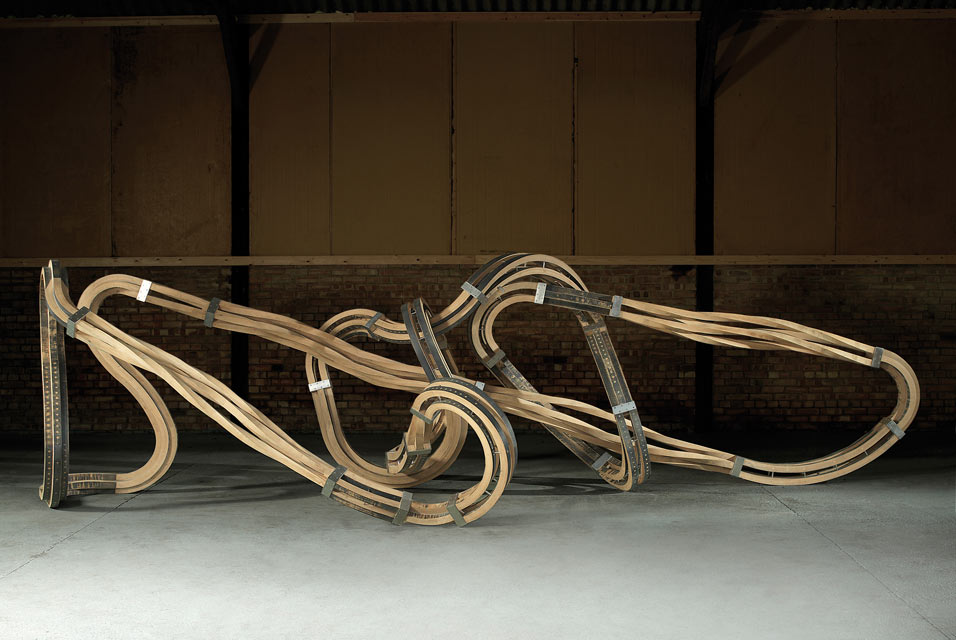
Quick, 2009. Chêne et acier. 180 × 622 × 231 cm. Strasbourg, Musée d’Art moderne et contemporain. Photo : Ken Adlard
Steel joints brace this piece entitled "Quick," allowing the wood to move in ways that might not happen naturally. "Organic …. and engineered," this piece makes an indirect connection between manufactured objects and biological forms because it's a little bit of both at several levels (movement, materials, techniques, etc.). More specifically, Deacon explores how material and construction techniques interact to delve into dualities of meaning at a subjective level. He says a lot about the modern world through the relationships at play in his work.
You can see his techniques and materials very clearly so that his process becomes part of the meaning of his pieces:
Deacon's sculptures relates to furniture-making in that they interact with the space around them and they usually interact with a lot of tension:
I think it's amazing how much can be said once techniques are mastered and then all mashed up with a variety of materials. It is inspiring to learn about someone who constantly explores his options in order to get exactly what he wants.
Deacon uses a wide variety of materials, from wood to polycarbonate and leather to ceramics, but for the sake of this class, I will consider one of his wood sculptures.
Steel joints brace this piece entitled "Quick," allowing the wood to move in ways that might not happen naturally. "Organic …. and engineered," this piece makes an indirect connection between manufactured objects and biological forms because it's a little bit of both at several levels (movement, materials, techniques, etc.). More specifically, Deacon explores how material and construction techniques interact to delve into dualities of meaning at a subjective level. He says a lot about the modern world through the relationships at play in his work.
You can see his techniques and materials very clearly so that his process becomes part of the meaning of his pieces:
His sculptures never seek to hide technical operations behind them, including assemblage, riveting, torsion, stretching, folding or strapping…His process starts with drawing but it always moves into industry fabrication. In the piece above, the wood was "steam(ed), then clamped and strapped onto metal and assembled using a system of metal fixtures."
Deacon's sculptures relates to furniture-making in that they interact with the space around them and they usually interact with a lot of tension:
...beholders clearly sense themselves in the force field between the sculpture and the surrounding space, and walking around the object search for views inside or through the object and the inner spaces enclosed by the sculpture as immaterial shapes, and for an immanent principle of order.More dualities that are cited about Deacon’s sculptures include "the struggle between chaos and order [and the struggle] between formlessness and rigorous structure."
I think it's amazing how much can be said once techniques are mastered and then all mashed up with a variety of materials. It is inspiring to learn about someone who constantly explores his options in order to get exactly what he wants.
Martin Puryear

The first time I saw “Ladder for Booker T. Washington,” the iconic split-sapling country ladder crafted by Martin Puryear, it was at the Modern Art Museum of Fort Worth. The 36-foot sculpture floats in a double-height concrete gallery designed specifically for it.
The ladder’s gleaming side rails meander upward, narrowing
to just over one-inch wide at the top. The stark beauty, impeccable craftsmanship, and arresting perspective are startling. Puryear deftly combines modern abstraction with traditional crafts and woodworking. Each piece always bears the deeply individualized markings of the handmade.Compared to many woodworkers who rely on machines for their precision, Puryear’s way of working is backwards. He uses machines for doing the gross stock removal and then, when it comes to the final refinements and fitting of joints and making things work together, he uses sharp-edged tools that he pushes by hand.
Puryear earned a BA from Catholic University in Washinton DC, an MFA from Yale University in 1971, and studied at the Royal Swedish Academy of Arts in Stockholm. He was greatly influenced by the indigenous crafts of Siera Leone where he served in the Peace Corps in the 1960’s.
“I’m interested in vernacular cultures, where people lived a little closer to the source of materials and the making of objects for use. Not to rely strictly on the history of art has always been an interesting process, to be looking into areas that we call craft and trades.” -Martin Puryear
In spite of his appreciation of the crafts and trades, Puryear considers what he does fine art. Ken Edwards, an artist colleague of mine whose own work evokes comparison to Puryear, attended the 2006 American Craft Council Conference in Houston where Puryear gave the keynote address. Puryear began his talk by saying, “I am somewhat puzzled why I was asked to be here. I am not of this group.”
Puryear’s art can not be easily categorized. Conservative critics have praised his work for being impeccably handmade. Progressive critics complained that it was excessive. Either way, the works of Martin Puryear speak eloquently for themselves. We viewers can not help but be curious about how they are made.
Thursday, September 9, 2010
Gerrit Rietveld, June.24.1888 - June.26.1964
An extraordinary dutch furniture maker and architect, was influenced by the De Stijl movement. The De Stijl movement favored a simplistic form and color in furniture; the form was reduced to vertical and horizontal lines and the colors were strictly primaries along with black and white.
Reitveld's Red and Blue Chair, as shown above was made in 1917 and after being influenced by the De Stijl movement, painted it with primaries along with black and white. This unique form and use of color became quintessential to Reitveld's work, until he broke off in 1928. He then succeeded his last style of architecture with a new one, it was called: Nieuwe Zakelijkheid. This new form of architecture entailed design which was a bit more angular, and free of decoration. Another example of his work influenced by the Nieuwe Zakelijkheid, was the Zig-Zag chair:
Ursula Von Rydingsvard!!!!!


What I’m most drawn to about this work is the way Rydingsvard uses mass to build the texture on the surface of her work. Although as I wrote that I realized it’s almost contradictory. Maybe it would be more appropriate to say I appreciate that there is no surface treatment to her work. The surface is rather the result of the process of construction, maybe even consequential???
I’m also really drawn to the poetic beauty of her work. She makes the conception of metaphor look easy!! Rydingsgard uses her process to achieve access to her memories. It is as though she has invented a way to connect with memories through the processes of construction, thus re-creating her experience and additionally orchestrating an experience for the viewer.
Can one still create a modern art-piece out of wood?
Rod, in response to your question, can one still make a modern art piece out of wood? I would say definitely yes!
For example ALISON ELIZABETH TAYLOR represented by a major new york gallery
and what about Martin Puryear, subject of many museum shows
For example ALISON ELIZABETH TAYLOR represented by a major new york gallery
and what about Martin Puryear, subject of many museum shows
Subscribe to:
Posts (Atom)